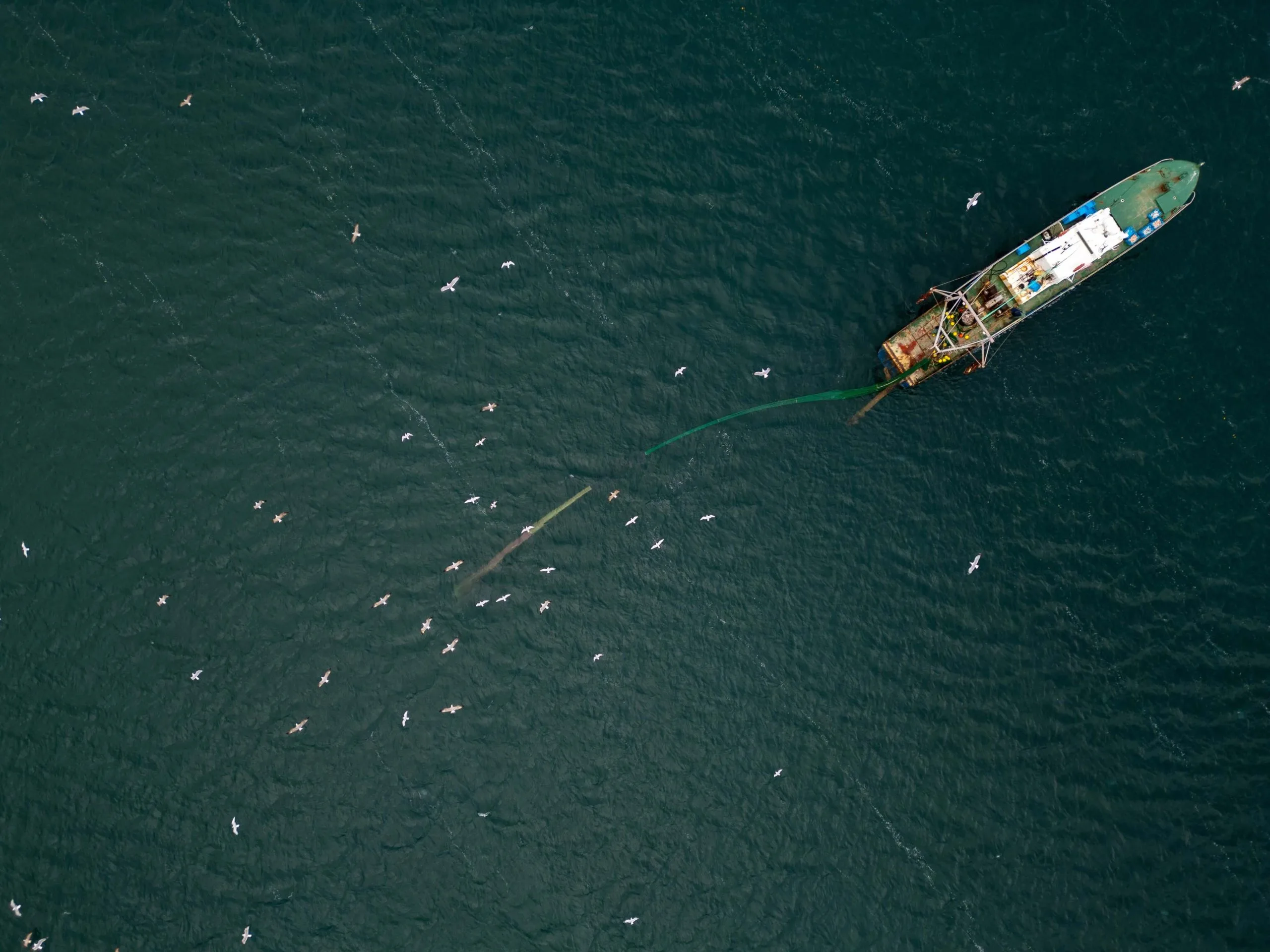
If you wanted to design a fishing method that removed marine life while tearing up the ecosystems that sustain it, you would struggle to do better than bottom trawling.
Heavy nets, steel doors and chains are dragged across the seabed to catch bottom-dwelling fish such as cod, hake and flatfish. In a single pass, bottom trawling captures target species while ploughing through the habitats they depend on to feed, shelter and reproduce. It is efficient in the short term and deeply destabilising in the long term.
Few fishing practices illustrate the difference between extracting from the ocean and stewarding it as starkly as this one.
At the Global Returns Project (GRP), we support charities working to protect marine ecosystems, strengthen fisheries governance and enforce environmental law. The evidence around bottom trawling shows why that work is so necessary and why banning or strictly limiting this practice is one of the clearest ways to prevent ecological decline.
Simplifying the seabed
Bottom trawling does not just remove fish. It simplifies the seabed.
Historical data from UK fisheries reveal the scale of the transformation. When researchers corrected for advances in vessel power and fishing technology, they found that landings per unit of fishing power fell by 94% over 118 years.
That dramatic decline reflects sustained fishing pressure but also the loss of seabed complexity. Reefs, sediments and benthic organisms that once provided shelter for juvenile fish were progressively degraded, reducing survival and long-term productivity.
In deep-sea systems, the consequences are even more severe. Many deep-water species grow slowly, mature late and can live for decades or even centuries. A global reconstruction estimated that bottom trawling removed around 25 million tonnes of deep-sea fish between 1950 and 2015, with up to 43% of catches unreported. Biological vulnerability combined with limited transparency creates ideal conditions for chronic overfishing.
This is why marine conservation organisations focus not only on catch limits, but on habitat protection itself. Blue Marine Foundation, for example, works to establish and expand marine protected areas (MPAs) where damaging activities like bottom trawling are restricted or banned, allowing seabed habitats and fish populations to recover together.
More effort, fewer fish
Overfishing is not defined by how many boats are at sea, but by whether fish populations can replace themselves. Bottom trawling frequently pushes fisheries beyond that biological threshold.
Across 62 countries between 2001 and 2020, researchers found that nations with high trawling intensity consistently had lower fishery outputs, even when they deployed more vessels and more fishers. In simple terms, more effort produced less fish.
This reflects a deeper ecological shift. As trawling degrades habitats and reduces spawning stock, the ecosystem’s carrying capacity shrinks. Even if fishing pressure remains constant, the maximum sustainable yield declines over time. What appears to be an economic challenge, falling returns is, at its core, an ecological one. Protecting habitats, therefore, is not anti-fishing. It is a strategy for sustaining productivity over the long term.
The hidden toll: bycatch and juvenile loss
Bottom trawling is inherently unselective. Demersal ecosystems contain mixed species, and trawl nets catch whatever lies in their path. The ecological footprint can be striking. In a Spanish bottom-trawl fishery, discarded catch accounted for 55% of the total ecological impact of fishing trips. These discards include juvenile fish, non-commercial species and damaged organisms, most of which do not survive. They add to fishing mortality without contributing to food supply or livelihoods.
The Mediterranean offers a stark example at scale. Around 75% of assessed fish stocks are overfished, and studies show that bottom trawls capture immature individuals in the majority of species assessed, even when legal mesh sizes are used. Catching fish before they reproduce is a direct route to recruitment overfishing quietly undermining the next generation of stocks.
Here, enforcement becomes as important as regulation. Legal advocacy organisations such as ClientEarth work to ensure that fisheries laws are upheld in practice, challenging destructive fishing in protected areas and pressing governments to align management decisions with ecological reality.
Recovery is possible
One of the strongest arguments for banning or restricting bottom trawling is what happens when it stops. After Hong Kong implemented a permanent bottom trawl ban in 2012, scientific surveys just three years later recorded clear signs of recovery: increased total fish biomass, a rise in predatory fish abundance and higher average trophic levels, all hallmarks of a healthier ecosystem. These improvements occurred despite ongoing pressures from coastal development and illegal fishing. Removing trawling pressure alone delivered measurable biological gains.
Similar recovery patterns have been observed in trawl-restricted areas around the world. This is why well-designed marine protected areas are such powerful and cost-effective interventions. By reducing pressure rather than subsidising further extraction, they allow ecosystems to rebuild themselves, often faster and more reliably than active restoration efforts.
Management determines outcomes
Bottom trawling is a high-risk fishing method. Where regulation is weak or effort excessive, it frequently leads to habitat degradation, declining productivity and long-term stock depletion. Where it is restricted or banned, recovery often follows.
At GRP, we support marine charities because they focus on these leverage points. Blue Marine Foundation works to secure large-scale protections that give ecosystems space to recover. ClientEarth ensures that destructive practices are challenged and that governments honour their legal obligations.
The evidence is clear: protecting the seabed is not about choosing nature over people. It is about choosing long-term abundance over short-term extraction, and ensuring that oceans can continue to feed communities for generations to come.
The question is not whether we can afford to limit bottom trawling. It is whether we can afford not to.
Support our work
References
Historical impacts and long-term stock decline
- Thurstan, R. H., Brockington, S., & Roberts, C. (2010). The effects of 118 years of industrial fishing on UK bottom trawl fisheries. Nature Communications, 1, 15.
- Thurstan, R. H., Hawkins, J., & Roberts, C. (2014). Origins of the bottom trawling controversy in the British Isles: 19th century witness testimonies reveal evidence of early fishery declines. Fish and Fisheries, 15, 506–522.
Deep-sea and global bottom trawling impacts
Fishing intensity, productivity, and overfishing thresholds
Bycatch, discards, and juvenile mortality
- García-Santiago, X., Franco-Uría, A., Antelo, L. T., Moreira, M. T., Feijóo, G., & Pérez-Martín, R. (2020). Environmental implications of discarding fish in Northern Spanish coastal bottom otter trawl fisheries. Fisheries, 45, 359–368.
- Lucchetti, A., Virgili, M., Vasapollo, C., Petetta, A., Bargione, G., Li Veli, D., Brčić, J., & Sala, A. (2021). An overview of bottom trawl selectivity in the Mediterranean Sea. Mediterranean Marine Science.
Habitat damage and indirect ecosystem effects
- Collie, J., Hiddink, J. G., van Kooten, T., Rijnsdorp, A. D., Kaiser, M. J., Jennings, S., & Hilborn, R. (2017). Indirect effects of bottom fishing on the productivity of marine fish. Fish and Fisheries, 18, 619–637.
- Norderhaug, K. M., Nedreaas, K., Huserbråten, M., & Moland, E. (2020).
Depletion of coastal predatory fish sub-stocks coincided with the largest sea urchin grazing event observed in the NE Atlantic.Ambio, 50, 163–173.
Recovery after trawl bans
Size structure, population truncation, and vulnerability